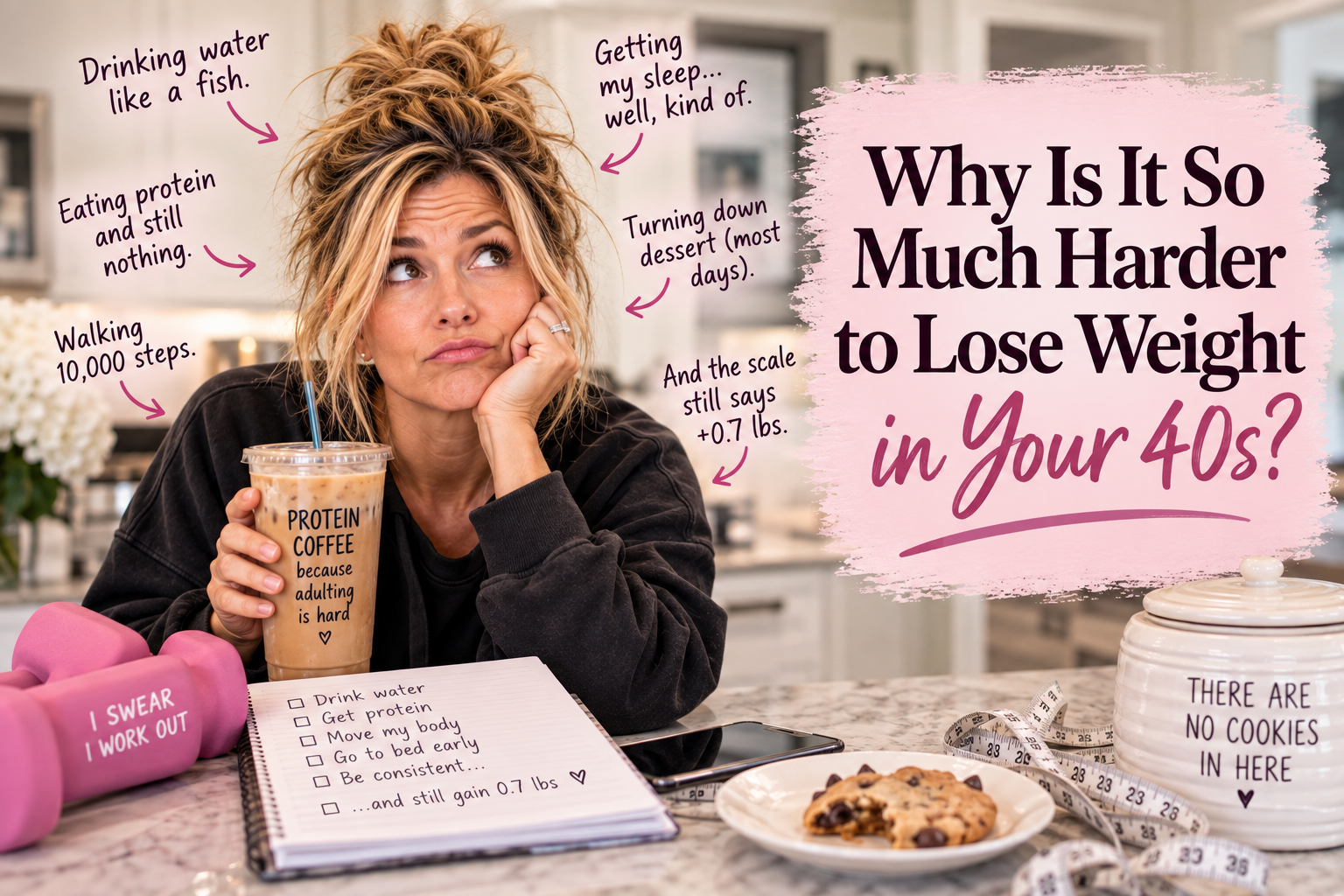
I would like to know who changed the rules.
There was a time when I could decide I needed to lose a few pounds, eat better for a week or two, move a little more, and my jeans would loosen up.
Now?
I can eat protein, drink water all day, get my steps in, turn down dessert, and go to bed feeling incredibly responsible.
Then I step on the scale the next morning.
Up 0.7 pounds.
Oh, okay.
Good talk.
Meanwhile, my child can survive on waffles and fruit snacks and has visible abdominal muscles.
So what exactly is happening here?
Is Your Metabolism Tanking at 40?
This is what we’ve all been told, right?
You turn 40, your metabolism packs a suitcase, leaves the house, and apparently takes your waistline with it.
Except that’s not really what the research shows.
One large study that measured energy expenditure across the lifespan found that, after accounting for differences in body size, metabolism was surprisingly stable between roughly ages 20 and 60.
So no, your metabolism doesn’t just fall off a cliff on your 40th birthday.
Which is honestly disappointing because I was prepared to blame it for everything.
Your Body Can Still Change
Just because your metabolism hasn’t suddenly abandoned you doesn’t mean you’re imagining things.
Body composition can change as we get older. Maintaining muscle becomes more important, and without things like resistance training and adequate nutrition, we can gradually lose muscle over time.
Then hormones decide they’d like to participate.
During the menopause transition, women can experience changes in body composition and where fat is stored. More fat may start accumulating around the abdomen.
This creates one of life’s great mysteries:
How can I weigh basically the same amount and somehow have a completely different body?
You put on jeans you’ve owned for three years and suddenly they’re cutting you in half.
Nothing happened to these jeans.
They’ve been sitting peacefully in a drawer.
Yet somehow they’ve betrayed you.
Sleep Is Not Helping
Then there’s sleep.
Maybe you went to bed at 10.
Technically, you were in bed for eight hours.
But you woke up because you were hot.
Then you had to pee.
Then your brain remembered something mildly embarrassing you did twelve years ago and decided we should spend some time with that.
Then at 5:42 AM a child appeared six inches from your face and whispered:
“Mom?”
So yes, you “slept eight hours.”
Sure.
Poor sleep can affect appetite, food choices, energy levels and how active we are the next day. And when you’re exhausted, nobody is standing in the pantry at 9 PM thinking:
You know what would really hit the spot right now? Some broccoli.
You Might Be Moving Less Without Realizing It
This one isn’t particularly fun either.
A lot of us spend more time sitting than we realize.
Work. Driving. Kids’ practices. Homework. Meetings. More driving.
Then you get home and discover that every person who lives there has apparently lost the ability to locate their own belongings.
So you’re definitely busy.
But being busy isn’t always the same thing as being physically active.
And unfortunately, carrying every grocery bag into the house at once because you’d rather lose circulation in four fingers than make a second trip does not count as a complete strength workout.
It should.
But it doesn’t.
Please Don’t Respond by Eating Nothing
This is where women can get themselves into trouble.
The scale isn’t moving, so you eat less.
Still nothing.
So you eat even less.
Before long, breakfast is coffee, lunch is six almonds and a yogurt, and you’re wondering why you’re exhausted and thinking about food at 9 PM.
You do not need to punish yourself into a smaller body.
Protein matters.
Strength training matters.
Regular movement matters.
Sleep matters.
Your overall eating pattern matters.
And if your weight has changed significantly without an obvious reason, there can be other things worth looking into, including medications, thyroid problems, sleep disorders and other medical issues.
Your 40-Year-Old Body Isn’t Your 25-Year-Old Body
And maybe we should stop expecting it to be.
The goal isn’t to spend the next decade desperately trying to make your body look exactly like it did before kids, careers, hormones, stress and actual adult life happened.
The goal is to be strong, healthy and comfortable in the body you have now.
Lift weights.
Eat your protein.
Move your body.
Sleep when your household allows it.
Eat the cookie sometimes.
And if you eat the cookie while hiding in the pantry because you don’t want your children to hear the wrapper and immediately ask for half of it…
No you didn’t.
There was never a cookie.
Apparently, this is 40.
This article is for educational purposes only and isn’t a substitute for individualized medical advice, diagnosis, or treatment.
Leave a Reply