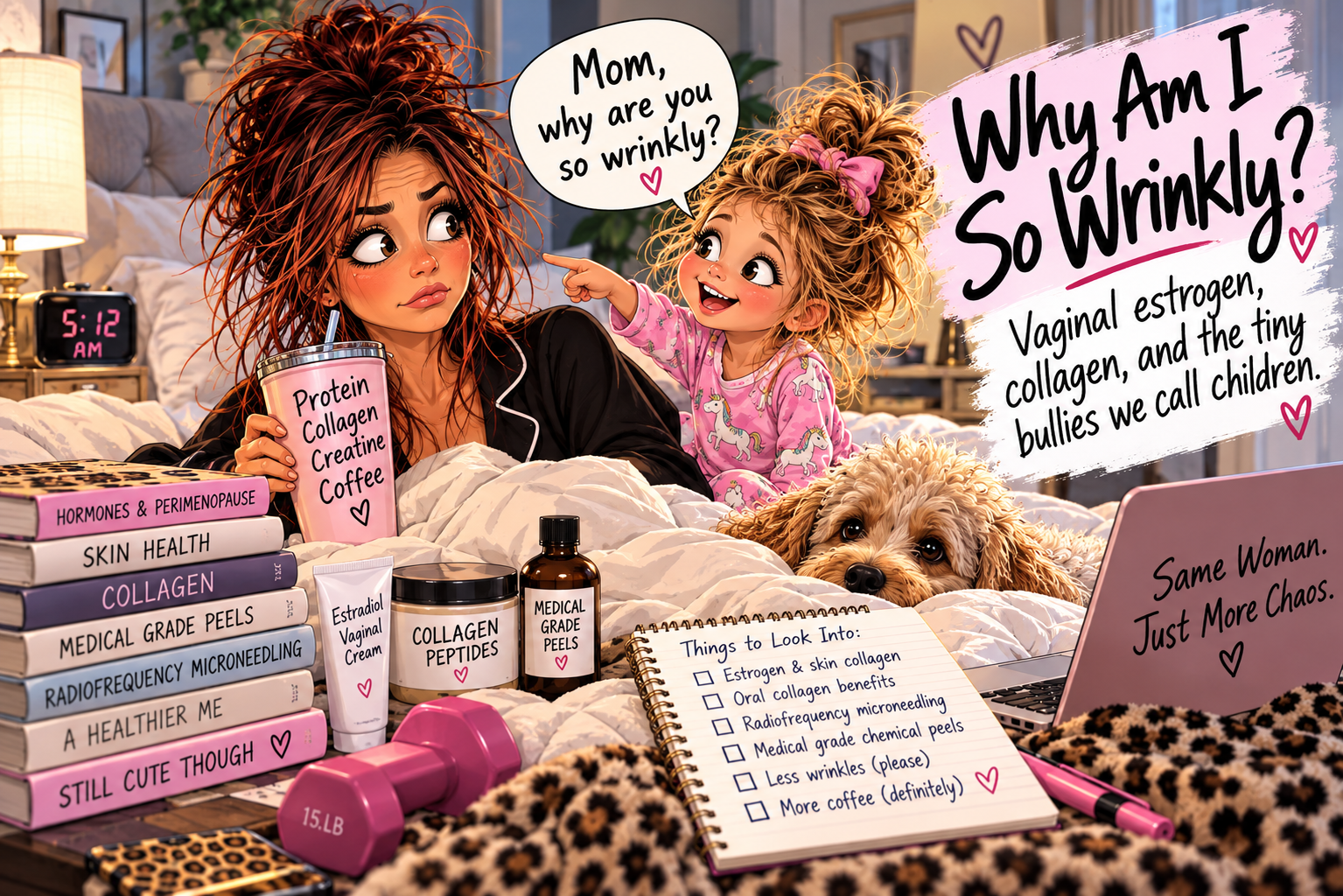
Vaginal estrogen, collagen, and the tiny bullies we call children.
I woke up this morning rather abruptly when my five-year-old marched into my bedroom and flipped on the lights.
As I squinted and frowned at the sudden assault on my eyeballs, she looked at me and asked, “Mom, why are you so wrinkly?”
Well, good morning, Princess. Thank you for the blunt reminder that I am no longer 20.
How do you even answer that?
Because I have kids? Because you just turned on the lights at an ungodly hour and my face hasn’t had time to wake up?
And I absolutely refuse to say it’s because I’m old. Old is 85. I’m nowhere near that, thank you very much.
Then there’s another family favorite: “Mom, why is your belly so squishy?”
I mean, it’s a good thing they’re cute.
Children are basically tiny, feral raccoons who live in your house, eat all your food, destroy your belongings, and occasionally attack you with words. And the worst part? They’re completely innocent about it.
Apparently, motherhood involves being emotionally humbled by someone who still needs help wiping their own butt.
So Naturally, I Had a Thought…
What if I just put my vaginal estradiol cream on my face?
Hear me out.
Vaginal estrogen helps restore and maintain vaginal tissue, improving moisture, thickness, and elasticity. It also helps prevent recurrent urinary tract infections in postmenopausal women.
Observational research has even linked vaginal estrogen prescriptions with lower rates of sepsis, hospitalization, and death in women with recurrent UTIs. That doesn’t prove estrogen directly prevents those outcomes, but it’s certainly interesting.
So if estrogen can help restore tissue downstairs, why can’t it do something about the situation happening upstairs?
Apparently, I’ve reached the age where I’m contemplating whether my vagina’s skincare routine should be shared with my face.
And surprisingly, there is some science behind that thought.
Does Estrogen Actually Help Skin Collagen?
Our skin contains estrogen receptors. Estrogen influences collagen production, skin thickness, elasticity, and hydration.
As estrogen levels decline during menopause, skin can become thinner, drier, and less elastic.
A small 2017 clinical trial found increased type I and type III collagen in facial skin after 24 weeks of topical estradiol treatment.
However, other studies haven’t demonstrated meaningful improvements in wrinkles. The research is mixed, and we don’t yet have established facial dosing or long-term safety data for estrogen creams.
So no, I’m not suggesting everyone start smearing their vaginal estrogen on their foreheads.
But the relationship between estrogen and skin aging deserves more research.
Especially for those of us being verbally assaulted before our first cup of coffee.
What About Taking Collagen?
Now here’s something I actually do.
I put collagen powder in my morning protein coffee, along with my protein powder and creatine.
At this point, my coffee has so many ingredients it probably qualifies as breakfast.
But does swallowing collagen actually help our skin?
Possibly.
Collagen peptides are broken down during digestion into amino acids and smaller peptides. Some of these may influence processes involved in collagen production.
Several randomized controlled trials have reported improvements in skin hydration and elasticity after approximately 8–12 weeks of oral collagen supplementation.
However, the benefits are generally modest, studies vary considerably, and some are industry-funded. More rigorous research has questioned how consistently these benefits hold up.
Read the research on oral collagen and skin aging
Most studies have investigated approximately 2.5–10 grams of hydrolyzed collagen daily.
Here’s something else worth knowing: collagen isn’t a complete protein. It lacks tryptophan and shouldn’t replace adequate dietary protein.
So while I enjoy putting collagen in my coffee, I’m not expecting to wake up looking 22.
I’d settle for looking well-rested and not being interrogated about my forehead.
What About Treatments That Actually Stimulate Collagen?
If we’re talking about collagen, we should probably discuss treatments that encourage our skin to produce more of its own.
Radiofrequency Microneedling
This treatment combines tiny needles with radiofrequency energy delivered into the skin. The controlled injury and heating stimulate the skin’s natural repair response, including collagen remodeling.
Research suggests radiofrequency microneedling can improve fine lines, skin texture, and certain types of acne scarring. Results develop gradually over several months, and multiple treatments may be recommended.
It isn’t a facelift in disguise, but it can produce meaningful improvements in appropriately selected patients.
Of course, there are risks, including burns, scarring, pigmentation changes, and unwanted fat loss. Proper technique, device settings, and patient selection matter.
Medical-Grade Chemical Peels
Chemical peels use carefully selected acids to exfoliate the skin at different depths.
Depending on the formulation and depth, they can improve uneven pigmentation, rough texture, and fine lines. Some deeper peels also stimulate dermal remodeling.
But not every peel stimulates significant collagen production. Superficial peels primarily improve the skin’s surface, while deeper treatments carry greater risks and recovery time.
And no, a stronger peel isn’t automatically a better peel.
The goal isn’t to look 20 again. It’s to maintain healthy skin and feel good about the face staring back at us.
Even when our children apparently have concerns about it.
So What’s the Verdict?
Aging skin is influenced by genetics, hormones, changes in collagen, and environmental factors. Even people with minimal sun damage develop wrinkles.
Estrogen clearly plays a role in skin biology, but using topical estrogen specifically to reverse facial aging remains an area of investigation.
Oral collagen supplements may offer modest benefits, although the research is less convincing than supplement advertisements would have you believe.
Professional treatments such as radiofrequency microneedling and appropriately selected chemical peels may improve skin texture and signs of aging, but they aren’t magic erasers.
And none of this changes the fact that my five-year-old apparently woke up and chose violence.
So I’ll continue drinking my protein coffee, following the research, and attempting to age gracefully.
And the next time she asks why I’m so wrinkly, I think I’ll tell her:
“Because every time you wake me up by turning on the lights, another wrinkle appears.”
It’s not medically accurate.
But neither is expecting your mother to look 20 when you’ve been keeping her awake for five years.
Here’s to aging, collagen, coffee, and surviving the tiny bullies we willingly brought into this world.
Medical Research & References
- Topical estradiol and facial collagen — 2017 clinical trial
- Topical estrogen and facial skin aging — 2014 study
- Oral collagen supplementation and skin aging — systematic reviews
- Radiofrequency microneedling and skin rejuvenation — clinical research
- Chemical peels for photoaging and skin rejuvenation — clinical research
Medical disclaimer: This article is for educational purposes only and does not replace individualized medical advice. Prescription estrogen products should be used as directed by your healthcare professional.
Leave a Reply