Author: thisis40

  • Why Is It So Much Harder to Lose Weight in Your 40s?

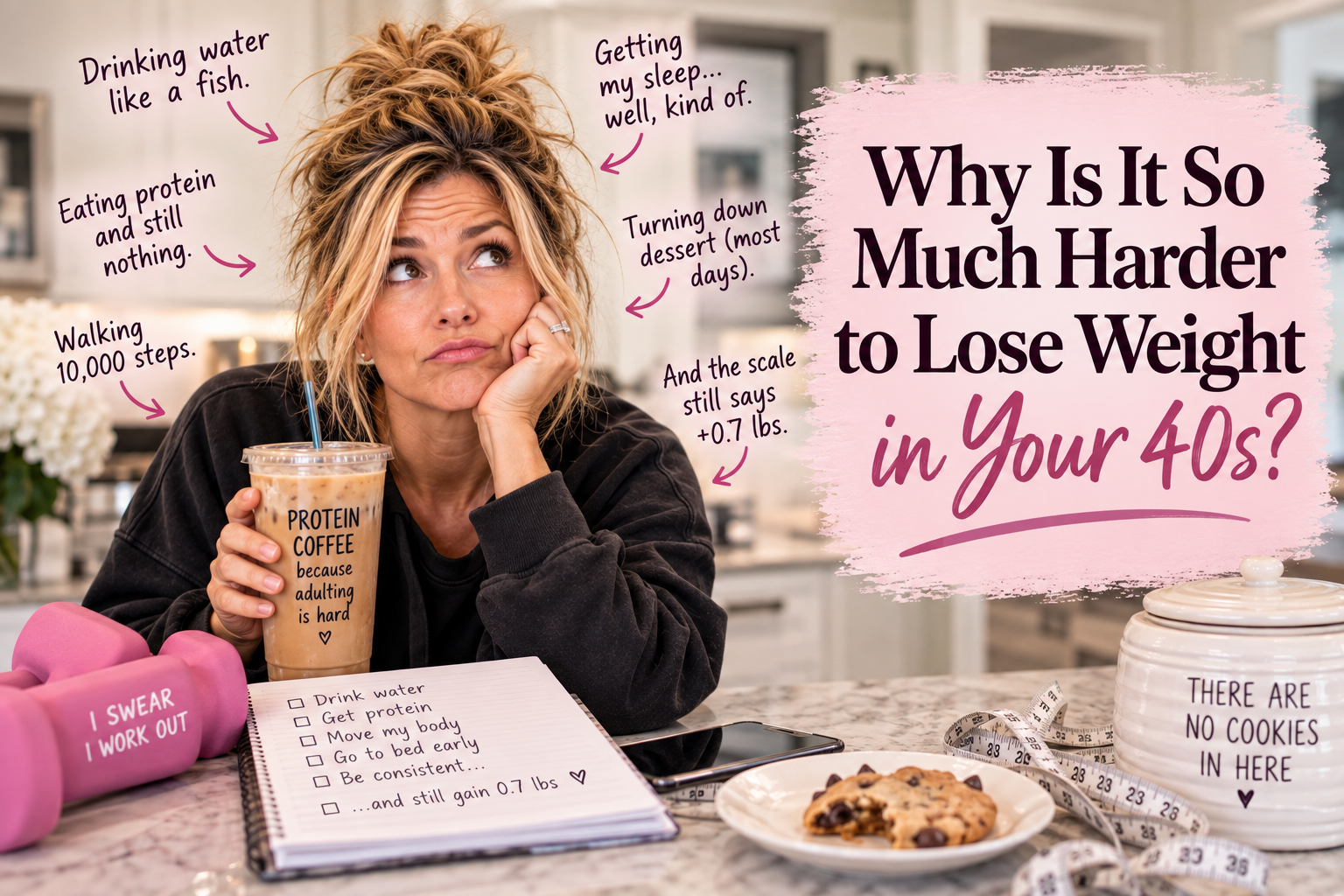
    Why Is It So Much Harder to Lose Weight in Your 40s?

    I would like to know who changed the rules.

    There was a time when I could decide I needed to lose a few pounds, eat better for a week or two, move a little more, and my jeans would loosen up.

    Now?

    I can eat protein, drink water all day, get my steps in, turn down dessert, and go to bed feeling incredibly responsible.

    Then I step on the scale the next morning.

    Up 0.7 pounds.

    Oh, okay.

    Good talk.

    Meanwhile, my child can survive on waffles and fruit snacks and has visible abdominal muscles.

    So what exactly is happening here?

    Is Your Metabolism Tanking at 40?

    This is what we’ve all been told, right?

    You turn 40, your metabolism packs a suitcase, leaves the house, and apparently takes your waistline with it.

    Except that’s not really what the research shows.

    One large study that measured energy expenditure across the lifespan found that, after accounting for differences in body size, metabolism was surprisingly stable between roughly ages 20 and 60.

    So no, your metabolism doesn’t just fall off a cliff on your 40th birthday.

    Which is honestly disappointing because I was prepared to blame it for everything.

    Your Body Can Still Change

    Just because your metabolism hasn’t suddenly abandoned you doesn’t mean you’re imagining things.

    Body composition can change as we get older. Maintaining muscle becomes more important, and without things like resistance training and adequate nutrition, we can gradually lose muscle over time.

    Then hormones decide they’d like to participate.

    During the menopause transition, women can experience changes in body composition and where fat is stored. More fat may start accumulating around the abdomen.

    This creates one of life’s great mysteries:

    How can I weigh basically the same amount and somehow have a completely different body?

    You put on jeans you’ve owned for three years and suddenly they’re cutting you in half.

    Nothing happened to these jeans.

    They’ve been sitting peacefully in a drawer.

    Yet somehow they’ve betrayed you.

    Sleep Is Not Helping

    Then there’s sleep.

    Maybe you went to bed at 10.

    Technically, you were in bed for eight hours.

    But you woke up because you were hot.

    Then you had to pee.

    Then your brain remembered something mildly embarrassing you did twelve years ago and decided we should spend some time with that.

    Then at 5:42 AM a child appeared six inches from your face and whispered:

    “Mom?”

    So yes, you “slept eight hours.”

    Sure.

    Poor sleep can affect appetite, food choices, energy levels and how active we are the next day. And when you’re exhausted, nobody is standing in the pantry at 9 PM thinking:

    You know what would really hit the spot right now? Some broccoli.

    You Might Be Moving Less Without Realizing It

    This one isn’t particularly fun either.

    A lot of us spend more time sitting than we realize.

    Work. Driving. Kids’ practices. Homework. Meetings. More driving.

    Then you get home and discover that every person who lives there has apparently lost the ability to locate their own belongings.

    So you’re definitely busy.

    But being busy isn’t always the same thing as being physically active.

    And unfortunately, carrying every grocery bag into the house at once because you’d rather lose circulation in four fingers than make a second trip does not count as a complete strength workout.

    It should.

    But it doesn’t.

    Please Don’t Respond by Eating Nothing

    This is where women can get themselves into trouble.

    The scale isn’t moving, so you eat less.

    Still nothing.

    So you eat even less.

    Before long, breakfast is coffee, lunch is six almonds and a yogurt, and you’re wondering why you’re exhausted and thinking about food at 9 PM.

    You do not need to punish yourself into a smaller body.

    Protein matters.

    Strength training matters.

    Regular movement matters.

    Sleep matters.

    Your overall eating pattern matters.

    And if your weight has changed significantly without an obvious reason, there can be other things worth looking into, including medications, thyroid problems, sleep disorders and other medical issues.

    Your 40-Year-Old Body Isn’t Your 25-Year-Old Body

    And maybe we should stop expecting it to be.

    The goal isn’t to spend the next decade desperately trying to make your body look exactly like it did before kids, careers, hormones, stress and actual adult life happened.

    The goal is to be strong, healthy and comfortable in the body you have now.

    Lift weights.

    Eat your protein.

    Move your body.

    Sleep when your household allows it.

    Eat the cookie sometimes.

    And if you eat the cookie while hiding in the pantry because you don’t want your children to hear the wrapper and immediately ask for half of it…

    No you didn’t.

    There was never a cookie.

    Apparently, this is 40.

    This article is for educational purposes only and isn’t a substitute for individualized medical advice, diagnosis, or treatment.
  • Why Am I So Irritable in My 40s? And Is It Perimenopause?

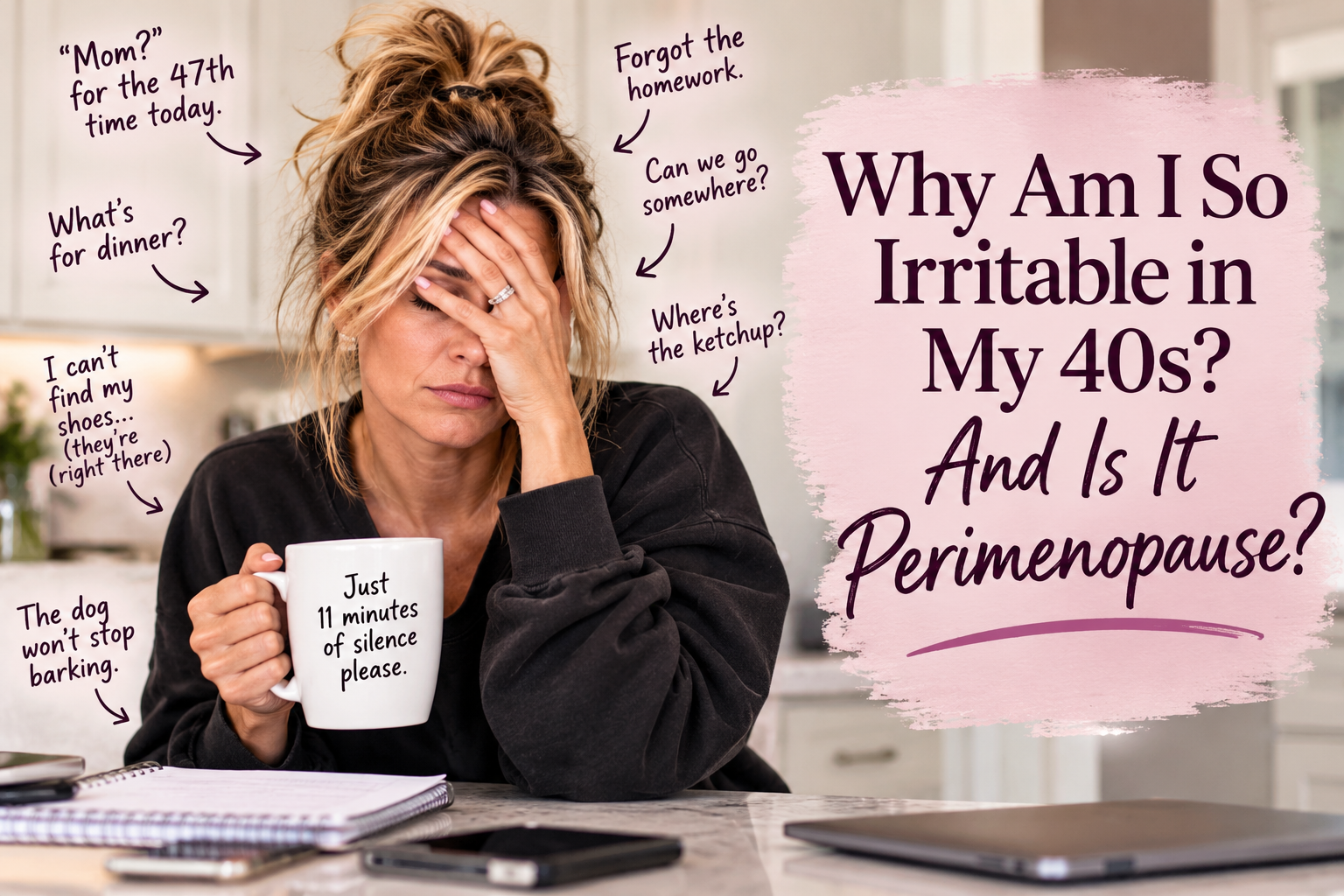
    Why Am I So Irritable in My 40s? And Is It Perimenopause?

    Maybe you’re not angry.

    Maybe you’re just 40 and everyone needs something from you at the exact same time.

    You’re making dinner. One kid needs help with homework. Another can’t find the shoes that are somehow directly in front of them. Someone is yelling “Mom!” from another room instead of simply walking twelve feet to find you.

    Then your husband walks in and asks:

    “What’s for dinner?”

    The dinner you’ve discussed twice.

    The dinner that’s written on the calendar.

    The dinner you bought groceries for while he was standing next to you.

    And for approximately three seconds, you find yourself wondering whether prison would really be that bad.

    Someone else cooks. No one asks you what’s for dinner. There may even be scheduled quiet time.

    Then you think:

    Why am I so freaking irritated lately?

    Irritability Can Be Part of Perimenopause

    Yes, mood changes can happen during the menopause transition. Some women notice increased irritability, anxiety, mood swings, or feeling less able to handle things that previously wouldn’t have bothered them.

    Hormonal changes may contribute, but they’re not necessarily the whole explanation.

    Sleep can also become disrupted during this stage of life. And shockingly, being exhausted while managing work, children, a house, relationships, appointments, laundry, groceries, and the 4,000 invisible tasks required to keep everyone alive doesn’t exactly improve anyone’s mood.

    Sometimes what feels like “I’m suddenly an angry person” is actually:

    I’m tired. I’m overstimulated. I’m carrying too much. And my tolerance for nonsense has officially left the building.

    But Don’t Blame Everything on Perimenopause

    This is important.

    Being irritable in your 40s does not automatically mean you have a hormone problem.

    Mood changes can also be related to stress, anxiety, depression, thyroid problems, sleep disorders, medications, alcohol, nutritional deficiencies, relationship problems, or simply having way too much on your plate.

    Sometimes hormones are contributing.

    Sometimes your life is genuinely overwhelming.

    And sometimes it’s both.

    What Should You Pay Attention To?

    Think about what’s different from your normal.

    Did the irritability suddenly get worse? Are you also noticing changes in your periods, sleep, hot flashes or night sweats? Are you feeling anxious or depressed? Are you exhausted all the time? Has anything else changed physically?

    Those details matter much more than simply saying:

    “Well, I’m 40 now.”

    If your mood changes are significant, persistent, interfering with your relationships or daily life, or just don’t feel like you, it’s worth talking with your healthcare provider rather than assuming you have to live with it.

    And No, You Haven’t Suddenly Become a Terrible Person

    There may actually be a reason your tolerance isn’t what it used to be.

    But there also isn’t a blood test that can look at your results and determine:

    Estradiol: fluctuating
    Sleep: questionable
    Mental load: 847% over capacity
    Number of times someone has yelled “Mom” today: critical

    Unfortunately.

    So if you’re standing in your kitchen wearing noise-canceling headphones while pretending you can’t hear anyone asking for another snack, you’re probably not alone.

    Figure out what’s actually contributing to how you feel.

    And maybe, just maybe, tell everyone where the ketchup is one final time.

    This article is for educational purposes only and isn’t a substitute for individualized medical advice, diagnosis, or treatment.

  • Can You Be in Perimenopause With Regular Periods?

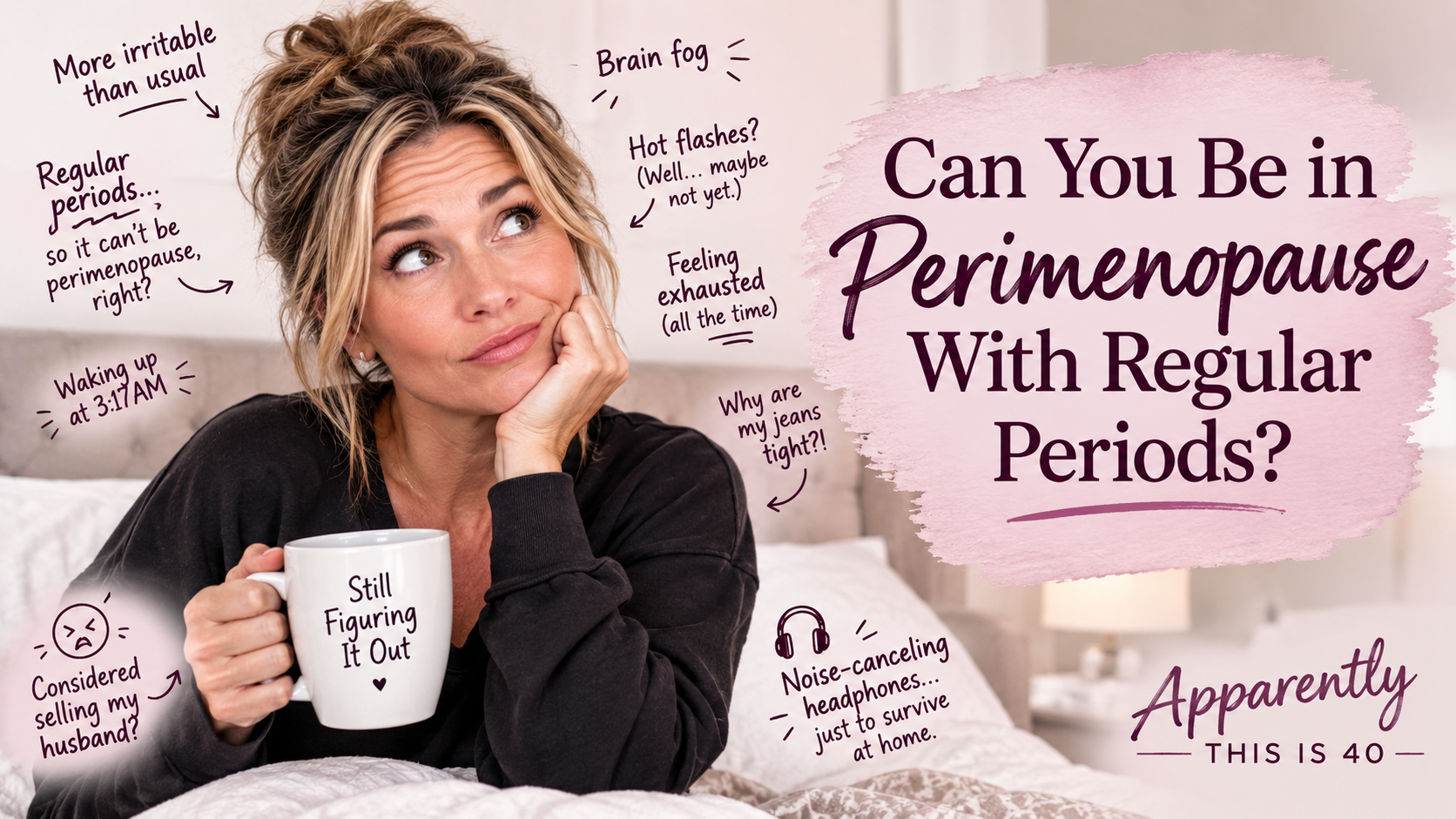
    Can You Be in Perimenopause With Regular Periods?

    Apparently, yes.

    I think a lot of us assumed perimenopause would be pretty obvious. Your periods would start getting weird, you’d have hot flashes, and eventually you’d think, Oh. This must be perimenopause.

    Except apparently our bodies did not agree to make this transition convenient.

    You can start experiencing symptoms associated with the menopause transition while your periods still seem regular. Menstrual changes are one of the most common early signs of perimenopause, though, so having regular periods plus a few symptoms doesn’t automatically mean you’re in perimenopause.

    But maybe lately you’ve noticed some things.

    You’re more irritable than usual. You’ve briefly considered selling your husband because of the way he chews. You’re wearing noise-canceling headphones around your own house because apparently everyone needs to make noise at the exact same time.

    You walk into a room and have absolutely no idea why you’re there.

    You wake up at 3:17 AM for no apparent reason and your brain decides this would be an excellent time to review something embarrassing you said in 2009.

    You’re exhausted even though you technically slept.

    And despite eating basically the same way you always have, your jeans have suddenly declared war.

    Naturally, you start wondering:

    What the hell is happening to me?

    Then your period arrives exactly when it’s supposed to.

    Well, I guess it can’t be perimenopause.

    Not necessarily.

    Hormones Don’t Follow a Nice Little Schedule

    Hormone levels can fluctuate during the years leading up to menopause. They don’t simply decrease in a nice, predictable straight line.

    As the menopause transition progresses, changes in your menstrual cycle generally become more noticeable. But your experience isn’t determined solely by whether your period showed up this month.

    At the same time, this is where I think we need to be careful.

    Not everything that happens to a woman around 40 is perimenopause.

    Social media would have you believe that if you’re 38 and annoyed by your family, estrogen is obviously responsible.

    Unfortunately, sometimes your family is just annoying.

    Fatigue, mood changes, trouble sleeping, brain fog and weight changes can have plenty of other causes. Thyroid problems, iron deficiency, sleep disorders, medications, stress, pregnancy and other medical conditions can cause symptoms that overlap with perimenopause.

    So the answer shouldn’t automatically be:

    “You’re 40. It’s your hormones.”

    We should actually figure out what’s going on.

    What About Checking Your Hormones?

    This part can be frustrating.

    Hormone levels can fluctuate during the menopause transition. One blood draw is one moment in time, so a single hormone result doesn’t always tell the whole story.

    For many women, especially those 45 and older with typical symptoms, perimenopause is identified primarily from age, symptoms and menstrual changes rather than one magical blood test.

    There is, unfortunately, no lab result that pops up and says:

    CONGRATULATIONS. YOU HAVE OFFICIALLY ENTERED THE WTF YEARS.

    That doesn’t mean testing is never useful. Depending on your age, symptoms and medical history, your healthcare provider may order testing, particularly if something else could be causing your symptoms.

    The bigger picture matters: what’s changed, how long it’s been happening, your menstrual pattern, your medical history and whether another condition needs to be ruled out.

    So, Yes. Your Period Can Still Seem Regular

    If you’re somewhere around 40 and suddenly don’t quite feel like yourself anymore, don’t dismiss what you’re experiencing just because your period still shows up every month.

    But don’t automatically blame everything on perimenopause either.

    Maybe your hormones are changing.

    Maybe your thyroid needs checked.

    Maybe you’re iron deficient.

    Maybe you desperately need sleep.

    And maybe the sound of your husband chewing really is just that annoying.

    Sometimes hormones are part of the explanation.

    Sometimes they’re not.

    And figuring out the difference is kind of the whole point of Apparently This Is 40.

    This article is for educational purposes only and isn’t a substitute for individualized medical advice, diagnosis, or treatment.