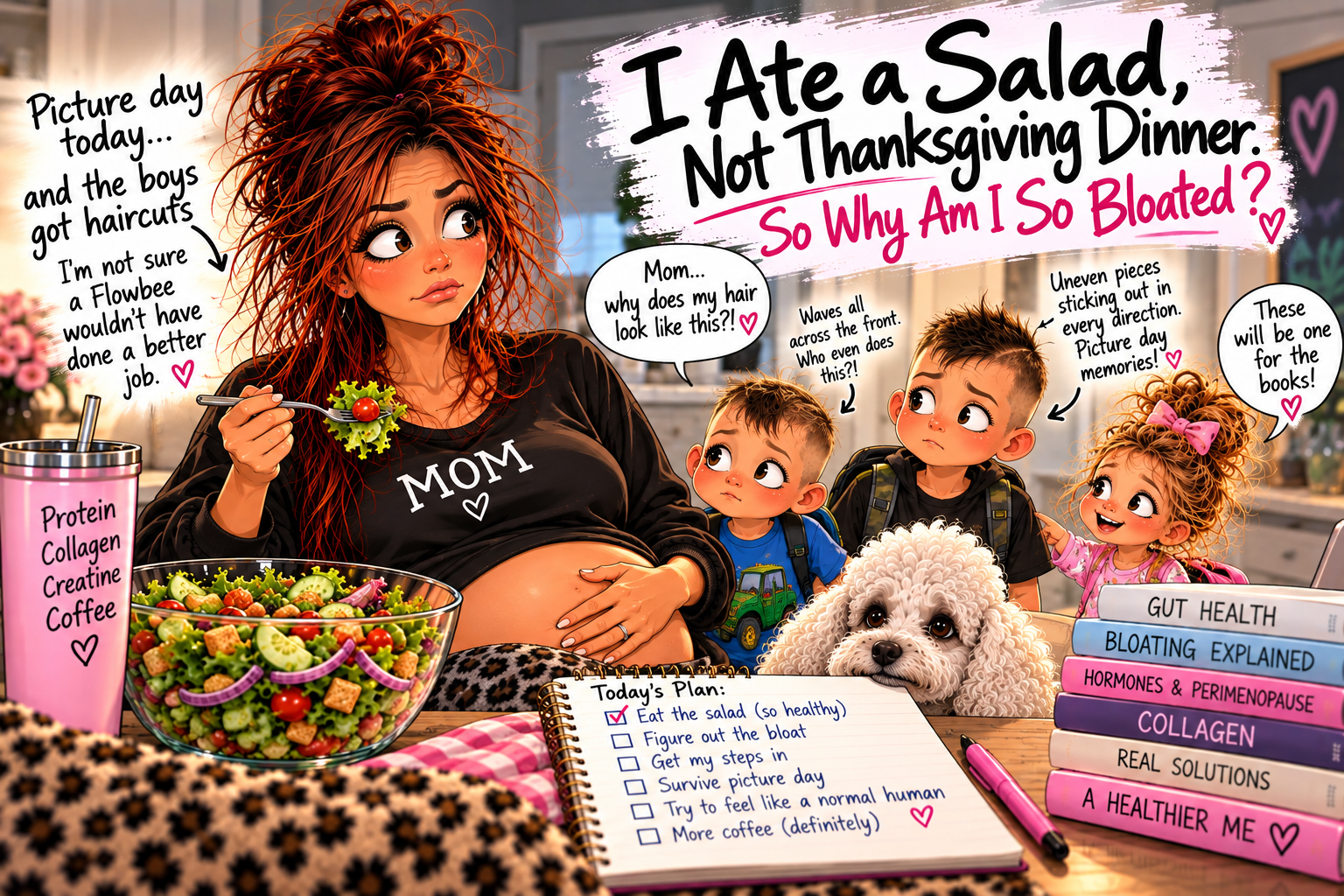
I woke up thinking, hey, maybe I lost a pound.
But I don’t dare step on the enemy because that thing tells lies. Not the good ones either. The kind that bring tears to your eyes and make you question every healthy decision you’ve made during these what-the-hell years.
So today was going to be a good day.
I was going to eat right, get my steps in, be intentional. All the things.
First, get the kids off to school. We managed to avoid a mild civil war, which I consider a parenting victory.
It’s picture day, you know.
And the two boys got haircuts.
I’m not sure a Flowbee wouldn’t have done a better job.
Their normal girl was booked until next week. Sure glad I left those appointments on the calendar.
These pictures will be one for the books.
The youngest looks like someone cut his hair while riding a roller coaster. Waves all across the front. I’m not even sure how that’s possible.
The oldest has a cowlick that clearly nobody at that salon has ever encountered before. Now he has uneven pieces sticking out in every direction.
Happy yearbook memories, kids.
I know how that feels. I’m fairly certain my mother gave me bowl cuts right before picture day just so I’d have something to discuss in therapy 30 years later.
Anyway.
I ate a salad.
And now I’ve swelled up like an inflatable Halloween unicorn.
WHYYYYY?
I ate lettuce. Not an entire pizza. Not Thanksgiving dinner. Not the Halloween candy I bought three weeks early and swore I wouldn’t touch.
A SALAD.
Apparently, my digestive system saw those vegetables coming and decided to inflate the emergency life raft.
So now I’m sitting here with my pants digging into my stomach, wondering how something that’s supposed to be good for me has managed to ruin my afternoon.
And apparently, there’s actual science behind this nonsense.
Why Does My Stomach Look Pregnant After Eating?
First, bloating and abdominal distension aren’t exactly the same thing.
Bloating is the sensation of pressure, fullness, or swelling in your abdomen. Distension is when your abdomen physically gets bigger.
You can have one without the other, or you can be lucky enough to experience both.
And contrary to what my bathroom scale would probably have me believe, this isn’t suddenly five pounds of belly fat.
Research shows that bloating can involve intestinal gas, constipation, increased sensitivity of the digestive tract, and even changes in how your diaphragm and abdominal muscles respond.
That last one is especially interesting.
Sometimes your stomach sticks out not because it’s filled with an enormous amount of gas, but because your diaphragm contracts downward while your abdominal wall relaxes outward. This is called abdominophrenic dyssynergia.
Essentially, your abdominal muscles and diaphragm aren’t coordinating the way they should.
Your body is rearranging its internal furniture without asking permission.
Researchers have documented this phenomenon in people with visible abdominal distension.
Read the research: Abdominophrenic Dyssynergia — A Narrative Review
But Why Would a Salad Cause This?
Here’s where things get interesting.
Some vegetables contain carbohydrates that aren’t completely absorbed in the small intestine. They eventually reach the large intestine, where bacteria ferment them and produce gas.
These are often called FODMAPs.
And while that sounds like some complicated government program, it actually stands for fermentable oligosaccharides, disaccharides, monosaccharides, and polyols.
Try saying that three times while helping three children with homework.
Onions, garlic, cauliflower, and beans can be particularly troublesome for some people.
But lettuce? Lettuce is generally considered a low-FODMAP food.
So why did my stomach decide to become an inflatable Halloween decoration?
Well, apparently scientists have actually studied women whose stomachs swell after eating lettuce.
I’m not kidding. Someone received research funding to investigate this exact betrayal.
In a 2019 study published in Neurogastroenterology & Motility, researchers evaluated 12 women who experienced visible abdominal distension after eating lettuce.
Their abdominal circumference increased by an average of approximately 3.5 centimeters.
But here’s the surprising part.
They didn’t find a statistically significant increase in intestinal gas.
Instead, imaging showed that the diaphragm moved downward and the abdominal contents shifted outward.
Essentially, the abdominal muscles and diaphragm weren’t coordinating normally.
So your stomach can physically stick out after eating without being filled with enormous amounts of gas.
Now, this was a small exploratory study involving women who already had functional digestive disorders. It doesn’t mean lettuce causes this reaction in everyone, or that every bloated stomach is caused by muscle coordination.
But it does mean the lettuce might not be entirely innocent.
And for once, there’s actual published scientific evidence supporting the complaint that a salad made someone’s stomach stick out.
I feel strangely vindicated.
Although I would have preferred a flatter stomach over scientific validation.
Read the full lettuce study here — free journal article
And Then There’s Constipation. Because Apparently We Needed Another Problem.
Let’s discuss something nobody particularly enjoys talking about.
Pooping.
Or, more specifically, not pooping enough.
You can have a bowel movement every day and still be constipated.
If you’re straining, passing hard stools, or constantly feeling like you haven’t finished, things may not be moving as efficiently as they should.
And when stool moves slowly through the intestines, bloating can become a problem.
Think of your digestive tract as a highway.
Everything is supposed to keep moving.
But somewhere along the way, there’s a traffic jam, three construction zones, and somebody driving 35 in the passing lane.
Nothing is getting anywhere.
And adding a giant bowl of raw vegetables to an already backed-up digestive system?
Sometimes that’s like sending another 400 cars onto the interstate.
Fiber is important, but rapidly increasing it can worsen gas and bloating. The type of fiber matters, too.
If constipation is contributing to bloating, treating the constipation may improve both symptoms.
Read the research: AGA Clinical Practice Update on Bloating and Distension
Are My Hormones Making This Worse?
Now we’re getting into the territory of the what-the-hell years.
You know, that lovely stage of life when you can eat the same things, exercise the same amount, and somehow your body decides to respond differently.
Hormonal fluctuations throughout the menstrual cycle can contribute to changes in fluid retention and digestive symptoms.
Some women notice bloating around their periods.
And during perimenopause, when estrogen and progesterone levels can fluctuate unpredictably, digestive symptoms may become more noticeable for some women.
But I want to make something clear.
Not every uncomfortable symptom after 35 is caused by hormones.
I know. Disappointing.
It’s tempting to blame everything on estrogen because at least then we’d have someone to be angry with.
But persistent bloating deserves a closer look rather than automatically assuming it’s hormonal.
Your Gut and Brain Are Apparently in a Group Chat
Here’s another fascinating piece of digestive science.
Your digestive tract and nervous system constantly communicate.
This is called the gut-brain axis.
And sometimes that communication gets a little dramatic.
People with conditions like irritable bowel syndrome may experience something called visceral hypersensitivity.
That means the nerves in the digestive tract are more sensitive to normal stretching and pressure.
So one person can eat a meal and feel perfectly comfortable while another feels like someone inflated a beach ball inside their abdomen.
The difference isn’t necessarily how much gas is present. It can be how sensitive the intestines are to it.
Stress can also influence digestive symptoms through the gut-brain connection.
Which is fantastic news for those of us who spend our mornings negotiating with children about socks, hairstyles, and why we cannot bring a live insect to school.
And no, this doesn’t mean the bloating is imaginary.
The symptoms are real. The nervous system simply plays a role in how they’re experienced.
Read the research: A Practical Approach to Abdominal Bloating and Distension
So How Do I Stop Looking Like a Parade Float?
Unfortunately, there’s no magical cure that works for everyone.
If there were, I’d be first in line.
But there are a few things worth trying before you give up on vegetables entirely.
Start by paying attention to what actually triggers your symptoms. Maybe it’s onions. Maybe it’s dairy. Maybe it’s eating an enormous meal after barely eating all morning.
You don’t have to eliminate everything at once. In fact, doing that can make it harder to figure out what’s actually bothering you.
Try cooking some of your vegetables instead of eating them raw. Some people find cooked vegetables easier to tolerate, although it depends on the food and the person.
Slow down while eating. I realize this is difficult when your lunch break consists of standing over the kitchen counter while someone yells that their sibling is breathing too loudly.
But eating quickly can increase swallowed air, which may contribute to digestive discomfort.
A short walk after eating may also help some people feel better.
And if you’re constipated, address that rather than continuing to add more and more fiber and hoping for a miracle.
For people with IBS, a short, structured trial of a low-FODMAP diet can sometimes help. It’s best done with guidance so you’re not unnecessarily eliminating nutritious foods.
Read the American College of Gastroenterology’s IBS guideline
One thing I wouldn’t automatically spend money on?
Probiotics.
Despite the marketing, they aren’t a universal solution for bloating. The American Gastroenterological Association’s clinical practice update advises against using probiotics specifically to treat abdominal bloating and distension.
There is still research exploring different strains and specific digestive conditions, but grabbing a random bottle off the shelf isn’t an evidence-based guarantee.
Neither is a detox tea.
Please don’t pay someone $49.99 to give you diarrhea and call it a cleanse.
Read the AGA recommendations on bloating and probiotics
When Bloating Isn’t Funny Anymore
Most occasional bloating isn’t a sign of something serious.
But if it’s persistent, getting worse, or happening regularly without an obvious explanation, it deserves medical attention.
Especially if you’re experiencing unexplained weight loss, blood in your stool, persistent vomiting, significant abdominal pain, or a new change in bowel habits.
Persistent bloating accompanied by pelvic pressure, feeling full unusually quickly, or increased urinary frequency also needs evaluation. Although these symptoms often have less serious explanations, they can occasionally be associated with ovarian disease.
And sudden severe abdominal pain, particularly with vomiting or an inability to pass stool or gas, requires urgent evaluation.
The point isn’t to scare anyone.
It’s to recognize that sometimes our bodies are being mildly irritating, and sometimes they’re trying to tell us something important.
We should know the difference.
Anyway, Tomorrow I’m Trying Cooked Vegetables.
I started today feeling optimistic.
Maybe I’d lost a pound.
Maybe I’d finally get my life together.
The children made it to school, although their yearbook pictures may someday be used as evidence in a lawsuit against the hair salon.
I made a healthy lunch.
And my abdomen responded by preparing for the Macy’s Thanksgiving Day Parade.
But here’s what I’m taking away from this.
Bloating doesn’t automatically mean you’ve gained weight. It doesn’t mean you failed at eating healthy. And it doesn’t mean you need to eliminate every enjoyable food from your life.
Sometimes your digestive system simply doesn’t appreciate your choices.
Tomorrow, maybe I’ll cook my vegetables.
Maybe I’ll take a walk after lunch.
And maybe I’ll wear pants with an elastic waistband.
Because at this point in life, I’m choosing my battles.
And today?
Lettuce won.
Disclaimer: This article is for general education and entertainment and is not a substitute for individualized medical advice. If you have persistent or concerning symptoms, consult a qualified healthcare professional.
Scientific References
- Moshiree B, Drossman DA, Shaukat A. (2023). AGA Clinical Practice Update on Evaluation and Management of Belching, Abdominal Bloating, and Distention: Expert Review. Gastroenterology. Read the journal abstract
- Abdominophrenic Dyssynergia: A Narrative Review. (2023). American Journal of Gastroenterology. Read the journal abstract
- Lacy BE, et al. (2021). ACG Clinical Guideline: Management of Irritable Bowel Syndrome. American Journal of Gastroenterology. Read the journal abstract
- A Practical Approach to the Diagnosis and Treatment of Abdominal Bloating and Distension. (2022). Gastroenterology & Hepatology. Read the full article
- Abdominal Distension After Eating Lettuce. (2019). Neurogastroenterology & Motility. Read the full article
Leave a Reply