Maybe you’re not angry.
Maybe you’re just 40 and everyone needs something from you at the exact same time.
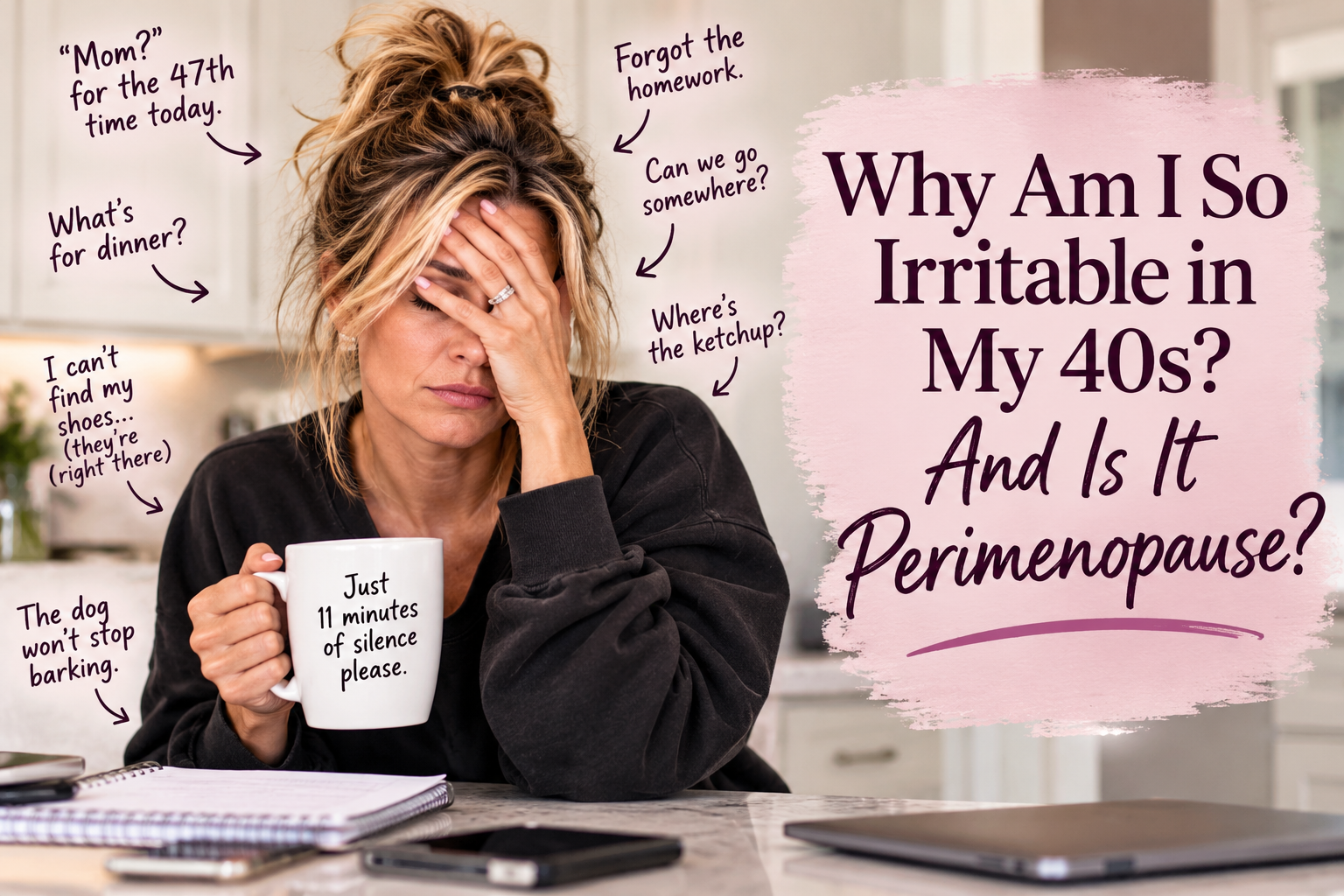
You’re making dinner. One kid needs help with homework. Another can’t find the shoes that are somehow directly in front of them. Someone is yelling “Mom!” from another room instead of simply walking twelve feet to find you.
Then your husband walks in and asks:
“What’s for dinner?”
The dinner you’ve discussed twice.
The dinner that’s written on the calendar.
The dinner you bought groceries for while he was standing next to you.
And for approximately three seconds, you find yourself wondering whether prison would really be that bad.
Someone else cooks. No one asks you what’s for dinner. There may even be scheduled quiet time.
Then you think:
Why am I so freaking irritated lately?
Irritability Can Be Part of Perimenopause
Yes, mood changes can happen during the menopause transition. Some women notice increased irritability, anxiety, mood swings, or feeling less able to handle things that previously wouldn’t have bothered them.
Hormonal changes may contribute, but they’re not necessarily the whole explanation.
Sleep can also become disrupted during this stage of life. And shockingly, being exhausted while managing work, children, a house, relationships, appointments, laundry, groceries, and the 4,000 invisible tasks required to keep everyone alive doesn’t exactly improve anyone’s mood.
Sometimes what feels like “I’m suddenly an angry person” is actually:
I’m tired. I’m overstimulated. I’m carrying too much. And my tolerance for nonsense has officially left the building.
But Don’t Blame Everything on Perimenopause
This is important.
Being irritable in your 40s does not automatically mean you have a hormone problem.
Mood changes can also be related to stress, anxiety, depression, thyroid problems, sleep disorders, medications, alcohol, nutritional deficiencies, relationship problems, or simply having way too much on your plate.
Sometimes hormones are contributing.
Sometimes your life is genuinely overwhelming.
And sometimes it’s both.
What Should You Pay Attention To?
Think about what’s different from your normal.
Did the irritability suddenly get worse? Are you also noticing changes in your periods, sleep, hot flashes or night sweats? Are you feeling anxious or depressed? Are you exhausted all the time? Has anything else changed physically?
Those details matter much more than simply saying:
“Well, I’m 40 now.”
If your mood changes are significant, persistent, interfering with your relationships or daily life, or just don’t feel like you, it’s worth talking with your healthcare provider rather than assuming you have to live with it.
And No, You Haven’t Suddenly Become a Terrible Person
There may actually be a reason your tolerance isn’t what it used to be.
But there also isn’t a blood test that can look at your results and determine:
Estradiol: fluctuating
Sleep: questionable
Mental load: 847% over capacity
Number of times someone has yelled “Mom” today: critical
Unfortunately.
So if you’re standing in your kitchen wearing noise-canceling headphones while pretending you can’t hear anyone asking for another snack, you’re probably not alone.
Figure out what’s actually contributing to how you feel.
And maybe, just maybe, tell everyone where the ketchup is one final time.
This article is for educational purposes only and isn’t a substitute for individualized medical advice, diagnosis, or treatment.
Leave a Reply