Category: Sleep & Energy

  • Why Am I So Tired All the Time? And Is This Just 40?

    Why Am I So Tired All the Time? And Is This Just 40?

    I am tired.

    Not “I stayed up too late last night” tired.

    More like I walk upstairs to get something, arrive upstairs, have absolutely no idea why I’m there, and eventually come back down carrying a random sock.

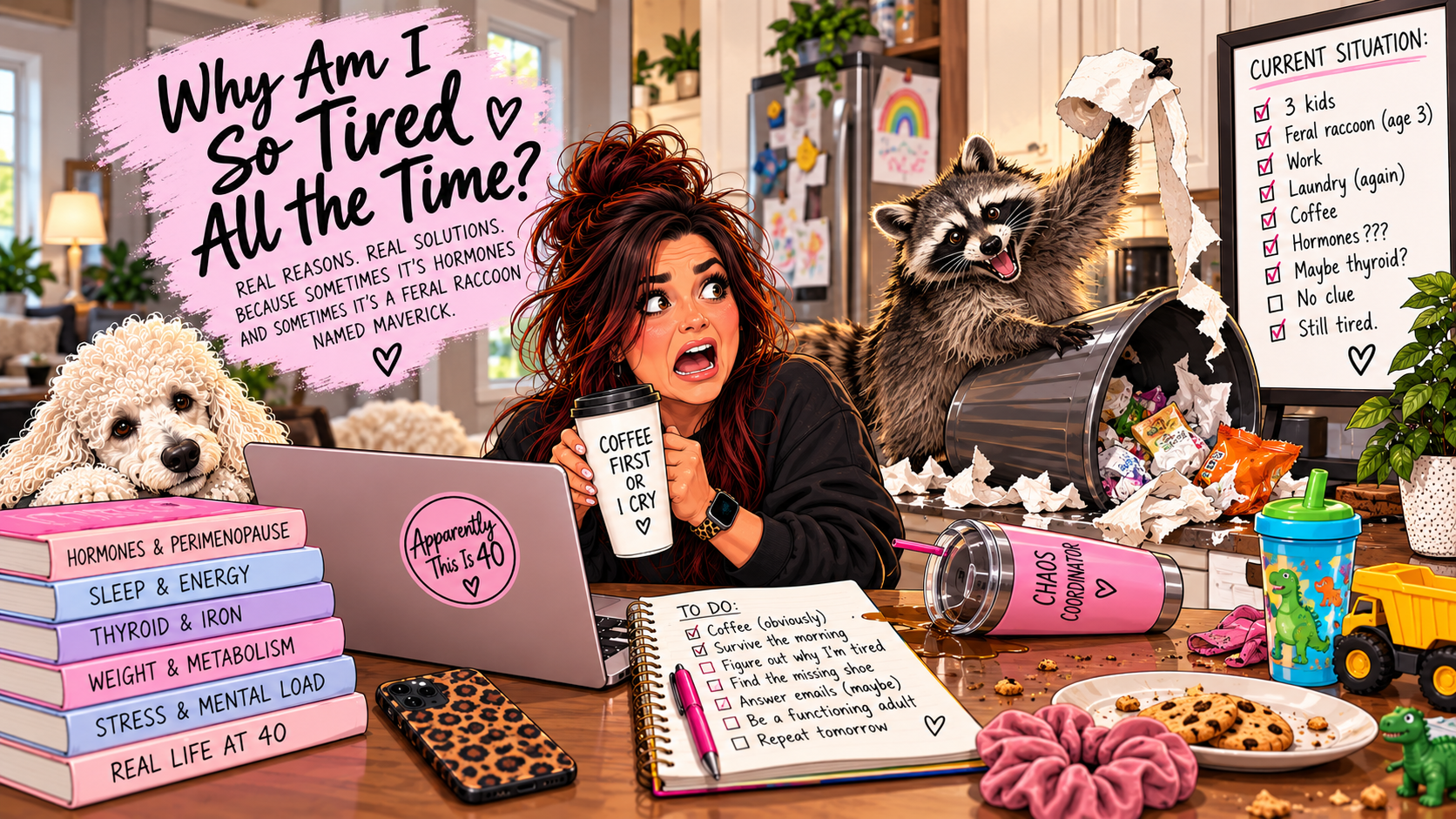
    Meanwhile, my youngest wakes up every morning like a feral raccoon who just found an unlocked dumpster.

    He’s ready.

    He’s energized.

    He has plans.

    None of them are good.

    And I haven’t even finished my coffee.

    So naturally I’ve wondered: Why am I so freaking tired all the time?

    Is it because I have three kids?

    Because I’m almost 40?

    Perimenopause?

    My thyroid?

    Iron?

    Do I need magnesium?

    Do I need to exercise?

    Do I need to stop exercising?

    Do I need to go to bed at 7:45 p.m.?

    Because at this point, I’m willing to consider it.

    First: being exhausted all the time isn’t something we should automatically accept

    Yes, life is exhausting.

    Work. Kids. Laundry. Dinner. Homework. Practices. Appointments. Remembering that apparently your child needs a plain white T-shirt for school tomorrow despite no one mentioning this until 8:37 p.m.

    But persistent fatigue can also have an actual medical cause. (MedlinePlus)

    And there are a few big ones worth knowing.

    1. Iron

    Especially if you still have periods.

    Iron deficiency can cause fatigue, weakness, headaches, dizziness, shortness of breath and trouble concentrating. Heavy periods increase the risk. (MedlinePlus)

    And no, this does not mean randomly taking iron because TikTok told you to.

    Iron can be checked.

    Common labs include a CBC and ferritin, with additional iron studies when appropriate. Too much iron isn’t harmless either. (MedlinePlus)

    So test. Don’t guess.

    2. Your thyroid

    An underactive thyroid can make you feel like someone unplugged you.

    Fatigue can come along with things like feeling cold, constipation, dry skin or hair, weight gain, muscle or joint aches and heavier or irregular periods. (MedlinePlus)

    The important part?

    Those symptoms aren’t specific to thyroid disease.

    Meaning being tired + gaining five pounds does not automatically mean your thyroid is broken.

    It means it’s one thing worth checking.

    3. Your sleep may suck even if you’re technically sleeping

    This one is rude.

    You can spend eight hours in bed and still have poor-quality sleep.

    Sleep apnea, for example, can cause daytime fatigue, trouble concentrating, headaches and frequent waking. And women don’t always have the stereotypical presentation of obnoxiously loud snoring. (NHLBI, NIH)

    So:

    “But I sleep eight hours.”

    Great.

    Are they eight good hours?

    Because lying unconscious next to a phone charger from 10 p.m. to 6 a.m. doesn’t automatically mean your sleep is restorative.

    4. Hormones

    Ah yes.

    Because apparently approaching 40 wasn’t exciting enough.

    During the menopausal transition, changing hormones can interfere with sleep and mood. Poor sleep can then show up during the day as fatigue and brain fog. (MedlinePlus)

    And perimenopause isn’t diagnosed because you turned 40 and yelled at someone for chewing too loudly.

    Your symptoms, menstrual changes, age and medical history all matter.

    Fatigue alone doesn’t equal perimenopause.

    Which is unfortunate because I personally enjoy diagnoses that require absolutely no additional investigation.

    5. Sometimes the answer really is your life

    There is also the possibility that you are legitimately doing too much.

    My brain currently contains:

    Did anyone feed the dog?

    What’s for dinner?

    Did I respond to that email?

    Someone needs toothpaste.

    There’s a birthday party Saturday.

    We’re out of milk.

    Why is there a wet towel on the floor?

    Who put this here?

    WHY IS IT STICKY?

    And somewhere in the background:

    “MOMMMMM!”

    You can have normal labs and still be exhausted because your brain hasn’t shut up since approximately 2018.

    So what should you actually do?

    If you’ve been unusually tired for weeks, it’s worth bringing up with your healthcare provider rather than just buying another supplement and hoping for the best. (MedlinePlus)

    The evaluation depends on your symptoms and history. Things like anemia/iron deficiency, thyroid disease, sleep problems, medications, mental health conditions and other medical causes may need to be considered. (MedlinePlus)

    Because “I’m a mom and I’m almost 40” isn’t a diagnosis.

    Sometimes you’re tired because life is bananas.

    Sometimes there’s a treatable reason.

    And sometimes you’re trying to research the cause of your fatigue while your three-year-old is wearing one shoe, no pants, and carrying something from the garage that you’re fairly certain he isn’t supposed to have.

    Which brings me back to my original theory.

    Feral raccoon.

    Apparently this is 40.

  • I’m Tired of Being Tired: What to Ask Your Provider When You Feel Like a Dumpster Fire

    I’m Tired of Being Tired: What to Ask Your Provider When You Feel Like a Dumpster Fire

    You love your family with every single part of you.

    But lately, you don’t feel like you’re showing up as the version of yourself they used to get.

    You’re there. You’re making dinner. Answering emails. Finding the missing shoe. Signing the school paper that apparently needed to be returned yesterday.

    Technically, you are functioning.

    But internally?

    Dumpster fire.

    Some days I feel a little like Jack at the end of Titanic. Everyone else got the whole damn door and I’m hanging onto the tiny corner life gave me, just trying to keep my head above water.

    And then someone asks what’s for dinner.

    I love my family more than anything. That’s actually part of what makes this so frustrating. I want to have energy for them. I want to play. I want to be patient. I want to get things done without every task feeling like it requires a congressional hearing inside my brain first.

    So when did being exhausted all the time become something women are just supposed to accept?

    “You’re a mom. Of course you’re tired.”

    No.

    There is a difference between “I stayed up too late and I’m tired today” and “I could lie down on this Target floor and comfortably live here now.”

    Fatigue is a symptom, not a diagnosis.

    Stress and an overloaded life absolutely can contribute. So can poor sleep. But persistent fatigue can also be associated with anemia or iron deficiency, thyroid disease, vitamin B12 deficiency, medication effects, sleep disorders, mood disorders, infections and other medical conditions. 

    That doesn’t mean you have one of those things.

    It means “I’m almost 40” isn’t a complete medical evaluation.

    What should you actually tell your provider?

    Don’t just say, “I’m tired.”

    Tell them what tired actually means.

    Has your exercise tolerance changed? Are you falling asleep during the day? Waking up exhausted after eight hours of sleep? Getting short of breath doing things that never bothered you before? Having heavier periods? Restless legs? Snoring? Brain fog? New headaches? Feeling unusually cold? Losing hair? Having palpitations?

    Also tell them when it started and whether anything else changed around the same time.

    Those details help determine what actually needs investigated.

    What about blood work?

    There isn’t one magical “fatigue panel,” and you don’t necessarily need 47 tubes of blood because TikTok told you that you do.

    Your history and symptoms should guide the workup. Depending on what’s going on, your provider may consider things such as a CBC, thyroid testing, metabolic testing, iron studies/ferritin, vitamin B12 or other targeted testing. Medication review, sleep quality and mental health also belong in the conversation. 

    Don’t forget iron just because your hemoglobin is normal.

    This one deserves its own section.

    Iron deficiency can exist without anemia. Ferritin reflects iron stores and is an important test when iron deficiency is suspected. Fatigue can occur with iron deficiency even before someone meets criteria for anemia. 

    That doesn’t mean everyone who’s tired should start swallowing iron.

    Please don’t.

    Too much iron can be harmful, and the reason for iron deficiency matters too.

    Get evaluated first.

    And yes, sleep counts.

    I know. Annoying.

    But there is a difference between spending eight hours in bed and getting eight hours of restorative sleep.

    Snoring, waking frequently, restless legs, insomnia and sleep apnea can leave you exhausted even when your bedtime looks impressive on paper. Sleep disorders are an important part of a fatigue evaluation. 

    If your partner says you snore like a chainsaw and occasionally stop breathing, maybe don’t immediately blame your hormones.

    Is it perimenopause?

    It could be part of the picture.

    But this is where I don’t love the internet’s tendency to make every symptom in a woman over 35 equal perimenopause.

    Hormonal changes can affect sleep and wellbeing. But being in your late 30s or 40s doesn’t suddenly make you immune to thyroid disease, iron deficiency, sleep apnea or everything else that can make a human feel terrible.

    You can investigate more than one possibility at a time.

    What can you do while you’re figuring it out?

    Start with the boring stuff because, unfortunately, the boring stuff matters.

    Eat enough. Get adequate protein and overall nutrition. Drink water. Move your body when you can. Protect your sleep. Pay attention to how much caffeine you’re using to compensate for exhaustion—and how late you’re drinking it.

    And please don’t decide that the answer to crushing fatigue is simply exercising harder.

    If your body suddenly isn’t tolerating activity the way it used to, that’s information worth paying attention to.

    What about supplements?

    This is where the internet gets especially wild.

    You probably don’t need a countertop full of powders with names like SUPER WOMAN ADRENAL HORMONE METABOLISM DETOX GODDESS ENERGY™.

    Supplements make the most sense when there is an actual reason to take them.

    Vitamin B12: If you’re deficient, replacement matters. But routine B12 testing or supplementation isn’t necessary for every healthy person. Risk is higher with certain dietary patterns, malabsorption and medications such as long-term metformin or acid-suppressing drugs. 

    Iron: Don’t affiliate-link an iron supplement with a “everyone should take this” message. Iron deficiency should be identified and the cause evaluated before blindly supplementing. 

    For affiliate links, I would instead naturally link products that are useful without implying they’ll cure fatigue—for example, your protein powder, insulated water bottle, sleep mask, walking pad, resistance bands or whatever products you genuinely use.

    The part I think we forget

    You don’t have to earn the right to investigate why you feel terrible.

    And you don’t have to wait until you’re completely falling apart.

    Maybe you’re still getting everyone where they need to go. Maybe you’re still working. Maybe the laundry is technically getting washed, although whether it ever leaves the basket is between you and God.

    You’re functioning.

    That doesn’t necessarily mean you’re feeling well.

    I don’t want to become some imaginary superhuman version of myself who meal preps on Sundays, works out at 5 a.m., drinks a gallon of water and has matching containers in her refrigerator.

    I just want enough energy to feel like me again.

    Because I love these people with my entire being.

    I’d just really like to stop feeling like Jack while they’re all comfortably sitting on the damn door.

    Medical disclaimer: This article is for general education and is not a diagnosis or individualized medical advice. Persistent, severe or unexplained fatigue should be discussed with your healthcare provider.

    Affiliate disclosure: This post may contain affiliate links. If you purchase through one of these links, I may earn a small commission at no additional cost to you. I only recommend products I genuinely think are useful.